Salisbury Diocesan Safeguarding Team
safeguarding@salisbury.anglican.org
01722 438651 — select option 2 for safeguarding concerns.
The diocese asks that non-urgent enquiries are made by email. For urgent concerns, call.
Visit diocesan safeguarding St Paul’s with FleetWEYMOUTH
CARE, SAFETY AND SUPPORT
Your safety matters. Your voice matters.
If you have been hurt, abused or made to feel unsafe, you deserve to be heard and supported. Abuse is never your fault. This is true whether it happened recently or many years ago, within the Church or elsewhere.
You do not need to be certain that something is abuse before asking for advice. You can contact a safeguarding officer about yourself or someone else. You can also seek support independently of the Church.
YOU DO NOT HAVE TO FACE THIS ALONE
We recognise the deep harm caused by abuse, including abuse committed in the Church and the harm caused when people have not been listened to. An apology alone is not enough: people need a safe response, practical support and action to protect others.
You can choose a source of support that feels right for you. You do not have to speak to the Vicar or anyone in this parish before contacting an independent service or the diocesan team.
The Church of England’s support directory includes independent services, survivor-led organisations and information about the Church’s support arrangements.
SPEAKING UP AND GETTING HELP
You can report current or non-recent abuse, concerns about a child or an adult at risk, or behaviour by a member of clergy, staff or a volunteer. If the concern is about someone in the parish—or you would prefer not to contact us—go directly to the diocesan team.
safeguarding@salisbury.anglican.org
01722 438651 — select option 2 for safeguarding concerns.
The diocese asks that non-urgent enquiries are made by email. For urgent concerns, call.
Visit diocesan safeguardingThirtyone:eight offers safeguarding advice and an emergency out-of-hours phone service.
Check current helpline hoursIf someone is in immediate danger, call 999.
For a non-emergency police report, call 101. You do not have to report through the Church first.
Family Support and Advice Line: 01305 228558.
Child safeguarding contacts and opening hoursDorset adult safeguarding: 01305 221016 (Monday–Friday, 8.30am–5pm).
Adult safeguarding informationFor Dorset social care emergencies outside the relevant service’s opening hours: 01305 221000. In immediate danger, call 999.
You can speak to any of the people below. Please use the diocesan route above if you prefer, or if your concern involves someone listed here. Parish emails and phones are not emergency services.


You should be listened to with care and taken seriously. You can ask what will happen next, who will contact you and what support is available.
Information should be handled sensitively and securely. We cannot promise complete secrecy: information may need to be shared with safeguarding professionals, the police or social care to protect someone. The reasons for sharing information should be explained to you.
National guidance explains the process and the support available during and after it. Support does not depend on the outcome of a safeguarding risk decision.
What happens after a concern is reported?
These services offer different kinds of help. Check each website for current opening hours, accessibility and ways to make contact.
For children and young people who want to talk about something worrying them.
Visit ChildlineAdvice for anyone concerned about a child’s safety or welfare.
Visit NSPCC HelplineSupport for adults who experienced abuse in childhood.
Visit NAPACRefuge’s free, 24-hour helpline for women experiencing domestic abuse and people supporting them.
Visit National Domestic Abuse HelplineSpecialist support about the abuse or neglect of older people.
Visit HourglassParenting and family support.
Visit Coram Family LivesA place to talk about whatever is troubling you, day or night.
Visit SamaritansFor concerns about preventing child sexual abuse, including worries about your own or someone else’s behaviour, Stop It Now offers specialist help. For keeping children safe online, see NSPCC advice.
OUR RESPONSIBILITY TO ONE ANOTHER
Our commitment is to a safer environment for children, young people and adults, to respond promptly to concerns and to support people affected by abuse. Safeguarding is part of the responsibility of the whole church community.
The following policy has been adopted by the Parochial Church Council for the Parish and the church; and by the Trustees of the Parish Hall, and for all their activities.
In accordance with the Church of England Safeguarding Policy we are committed to:
We will:
Each person who works within this church community will agree to abide by this policy and the guidelines established by this church.
This church appoints Mrs Sharon Waight and Ms June Hornby as the Parish Safeguarding Officers.
Incumbent: Fr. Gregory Attila Lipovsky
Churchwardens: Mrs Jeanne James; Mrs Anne Mullis
This policy has been discussed, revised and re-approved by St Paul's PCC. Date: 15 April 2026
Contact information and linked guidance checked on 23 November 2026. Service arrangements can change; the organisations’ own websites carry their latest information.
REMEMBERING IN PRAYER
At St Paul’s, an oil lamp burns day and night for victims of abuse. It stands by the Holy Trinity Altar, where a relic of St Maria Goretti is among those enclosed in the altar stone.
This light is a continuing sign of our prayer for all who have been harmed, and a reminder of our responsibility to listen, protect and offer practical support.
Let us pray for those who have suffered because of the wrongs done to them from members of the Church; may they find healing in Christ and within the Church herself a concrete response to their pain and suffering.
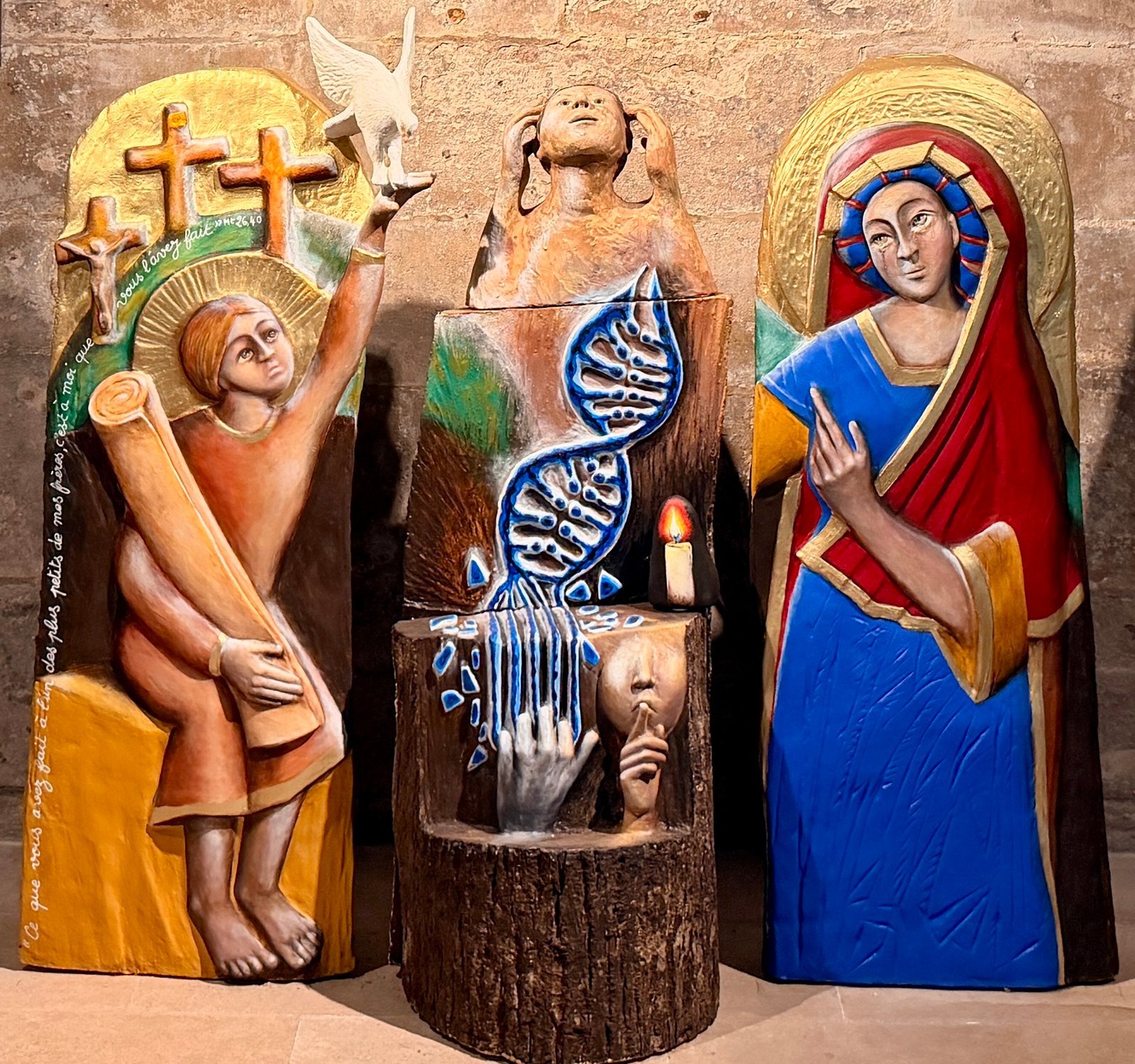
Memorial to the victims of abuse suffered within the Church by Dominique Colas (Saint-Pierre, Caen, France)
Carved out of lime tree trunks torn down by storms, it was modelled in unfired clay painted with oil and coloured with natural pigments. On the left, we can see the Infant Jesus sitting and holding the scroll of the Law. Saddened by the situation, he stretches his left arm to reach out to the child who feels ruined by the sufferings endured as a result of the abuse. Behind the Infant Jesus, on Golgotha hill, a character remains nailed to the cross: he has not acknowledged the evil he has done.
The white dove stands for the Holy Spirit: it shows that God cannot condone the crimes and offences committed within the Church. So many have been crushed by these acts of abuse and have been silenced by omertà.
The central figure of the child, wounded in body and soul, will keep these wounds for the rest of his life. Even the biology, represented here by the DNA chain, can record these sufferings and leave a lasting mark on an entire life and on the one that is passed on. The grey hand clutching the DNA represents the assault. With a finger on the lips, an unfinished face stands for the impossibility of speaking out and the imposition of silence. Above it, a burning candle symbolises all the support and vigilance that are necessary to prevent and heal relentlessly.
On the right, Mary, Mother of Jesus, who suffered seeing her Son tortured, humiliated, and killed, points her finger at the child for all of us to see. She reinforces the words of Jesus written on the left: "What you did it to one of the least of my brothers, you did it to me."