The angels and saints
We celebrate the saints with affection, offer Mass in their honour and ask their prayers. Their lives encourage us to follow Christ through the weaknesses and difficulties we share.
 St Paul’s with FleetWEYMOUTH
PLAN YOUR VISIT
Prayer at the heart of our life. A glimpse of heaven in our midst.
WHY WE GATHER
Worship is at the centre of our parish life. We come before God with all that we are: our gratitude and hopes, our needs and sorrows. We listen to his word, receive his gifts and learn to offer ourselves in love.
In the Mass, Christ nourishes us with himself. His forgiveness teaches us to forgive; his generosity teaches us to give. Gathered together despite our differences, we learn to love one another and are sent out to share the Gospel.
The prayer of the Church sustains everything else we do. Our service of our neighbours flows from the grace we receive in worship.
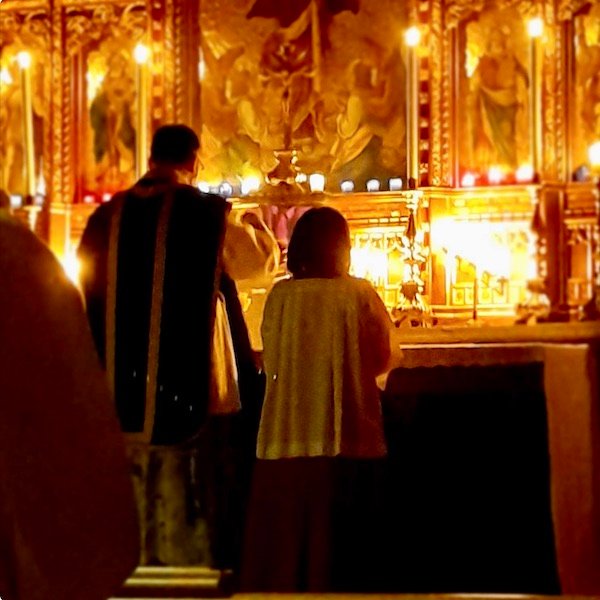
Our Anglo-Catholic tradition draws on the senses as well as words: vestments, incense, bells, music, images and sacred actions all help turn our attention towards God.
These signs remind us that we do not worship alone. Our prayer is joined to that of the angels and saints and to the unceasing worship of heaven. Beauty in the liturgy offers a glimpse of the life to which God calls us.
At St Paul’s, Sunday worship has a particularly rich ceremonial character, while weekday services are quieter. Incense is used at St Paul’s on Sundays; it is not used at Fleet.
You are welcome to watch, listen and join in as you become familiar with the service. For practical guidance, visit Your First Visit.
UNDERSTANDING THE SERVICES
Each service has its own character, but all draw us into the prayer and life of Christ. Open a heading to learn more.
Mass is also called the Eucharist or Holy Communion. We hear God’s word, offer prayer and thanksgiving, and receive Christ’s Body and Blood. You can ask the priest to offer Mass for a person or intention important to you: for someone who is sick, for the departed, for peace or for another need.
We normally use modern language, although some weekday Masses use traditional language.
These simple, spoken services bring together psalms, Bible readings and prayer. They give a rhythm to the day and join our personal prayer to the prayer of the Church.
We pray for the King, those in public life, the world, people in need, the suffering, our benefactors and the departed. The services use modern language, apart from the Bible readings.
Texts are printed in the parish magazine, so you can also pray at home and share in the parish’s daily prayer.
Evensong is a sung form of Evening Prayer, with hymns, psalms, Bible readings and prayers. We use the Book of Common Prayer and the King James Bible, giving the service its familiar traditional language.
In Anglo-Catholic worship, Evensong is often followed by Benediction. They are two distinct services, each offering its own way to pray.
In Benediction, the Blessed Sacrament—the Host consecrated at Mass—is placed on the altar, surrounded by candles and incense. We worship Jesus Christ, truly present under the appearance of bread, and offer prayer in his presence.
At the end, the priest blesses those present and the parish with the Blessed Sacrament.
The Rosary brings together the Our Father and repeated Hail Marys while we reflect on the mysteries of Christ’s life with Mary.
The joyful mysteries lead us through the Annunciation, Visitation, Nativity, Presentation and Finding of Jesus in the Temple. The sorrowful mysteries follow his Passion, from Gethsemane to the Cross. The glorious mysteries celebrate the Resurrection, Ascension, coming of the Holy Spirit, Mary’s Assumption and her Coronation.

FOLLOWING CHRIST THROUGH THE YEAR
At St Paul’s, we follow the traditional seasons of the Western Church. The unfolding story of Christ’s life is reflected in what we hear, sing and see.
Advent prepares us for his coming, Christmas celebrates his birth, Lent calls us to repentance, and Holy Week leads us through his Passion to the joy of Easter. Pentecost celebrates the gift of the Holy Spirit.
Our surroundings change with the season. In Advent and Lent, purple vestments, the absence of flowers and more restrained organ music express a quieter, penitential character. During Passiontide, images and statues are veiled in mourning.
Great feasts bring gold vestments, flowers and joyful bells. Black vestments and hangings express mourning and prayer for the departed.
We celebrate the saints with affection, offer Mass in their honour and ask their prayers. Their lives encourage us to follow Christ through the weaknesses and difficulties we share.
Mary, the Mother of Jesus, has a special place in our prayer. We keep her feasts, ask her intercession and honour her with flowers and candles before her images.
THROUGH THE SEASONS AND THE MONTH
Some services take place at particular times of the year or as part of our monthly pattern. Current arrangements are announced in This Week and the parish calendar.
Prayer with the laying on of hands asks God for healing and wholeness—physical, spiritual and mental. The priest places his hands on your head and prays quietly for you or for the person you bring before God.
Anointing is for those who are sick or frail. With the Oil of the Sick blessed by the bishop, the priest makes the sign of the cross, praying for forgiveness, strength and healing.
The Blessed Sacrament is placed on the altar so that we can spend time in the presence of Jesus. You can come to pray, listen or simply be still, for as long or as short a time as you are able.
During Lent, we follow Jesus’ journey from Pilate to the tomb, moving around the church and stopping at fourteen stations. Through prayer and reflection, we contemplate his Passion and the love with which he gave himself for us.
A relaxed opportunity to sing favourite hymns together, with a cup of tea or coffee and the company of others.
Readings, carols and prayer help us prepare for and celebrate the coming of Christ. These services belong to the distinctive worship of Advent and Christmas.
Check This Week for current service details, or explore the calendar for forthcoming feasts and special services. If you are new, our first-visit page will help you feel at home.